Features
Part of One plant, six processing routes: a field guide to specialty tea
Serving styles for specialty tea, compared side by side, with water as the wildcard
Five ways to serve specialty tea, with starting doses and times for each, plus why your brewing water changes the cup more than most people expect.
What to take away
- Five serving styles for specialty tea cover almost every situation, and four of them need no equipment you do not already own.
- The water you brew with changes the cup measurably, so it is the first variable to fix, not the last.
- Cold infusion pulls a different balance out of the same leaf and suits lightly oxidized tea best.
- Overdoing it usually means too much leaf, too long, or too many teas in one sitting. All three are easy to avoid.
- The gear named below, a basket infuser, a scale, a gaiwan, a cold brew pot and a shaker, typically totals under $100.
Starting numbers
All five formats use the doses below, measured per 100 mL of water. Grams mean dry leaf, not brewed liquor.
Starting doses and times
Leaf per 100 mL
- Plain mug
- 1.2 g
- Small pot, short steeps
- 5 g
- Cold infusion
- 1.2 g
- Flash chilled
- 2.4 g
- Batch for a table
- 1.2 g
Time
- Plain mug
- 2 to 4 min
- Small pot, short steeps
- 20 s, rising
- Cold infusion
- 8 to 12 h, chilled
- Flash chilled
- 3 min onto ice
- Batch for a table
- 4 min, then decant
Leaf
- Plain mug, 350 mL, basket infuser
- 1.2 g
- Small pot, 100 mL gaiwan or kyusu, short steeps
- 5 g
- Cold infusion, Hario Mizudashi 1 L
- 1.2 g
- Flash chilled, shaker onto ice
- 2.4 g
- Batch for a table, decant to a carafe
- 1.2 g
Time
- Plain mug, 350 mL, basket infuser
- 2 to 4 min
- Small pot, 100 mL gaiwan or kyusu, short steeps
- 20 s, rising
- Cold infusion, Hario Mizudashi 1 L
- 8 to 12 h, chilled
- Flash chilled, shaker onto ice
- 3 min onto ice
- Batch for a table, decant to a carafe
- 4 min, then decant
One: a 350 mL mug and a basket infuser
Water off the boil for black and dark tea, cooler for green and white. Aim for about 95 C (205 F) for black and 75 to 80 C (165 to 175 F) for green. Take the leaf out when the time is up.
A Finum Brewing Basket, typically $10 to $13, drops into most 350 mL mugs and lifts out in one motion. A 0.01 g pocket scale such as the American Weigh Scales AWS-100, about $12, holds the 1.2 g dose steady.
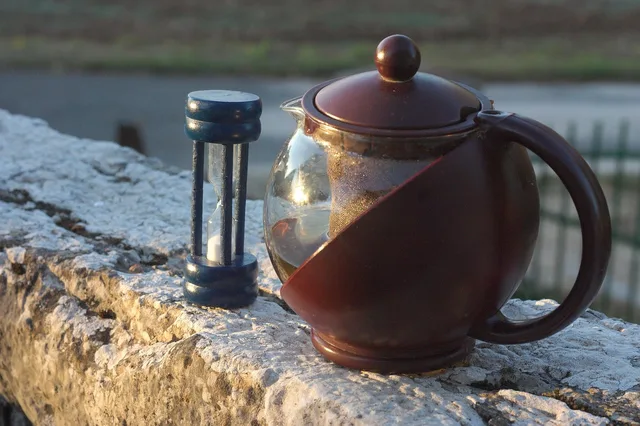
A mug with the leaf sitting in it all afternoon is not steeped tea, it is an extraction that never stopped, and it is the most common reason people decide they dislike a tea.
Two: a 100 mL gaiwan or a kyusu, several short steeps
More leaf, less water, short times, adding a few seconds each round. A 100 mL porcelain gaiwan, typically $15 to $30, and a Japanese kyusu of 200 to 300 mL with a ceramic sasame filter are the two classic vessels. Ippodo Tea, the Kyoto house founded in 1717, lists both in its English-language online shop.
You get four or five distinct cups from one measure of leaf instead of one flat cup. Sensory work putting the practical ceiling at four brews is quoted in how to judge a tea subscription. This is where oolong and dark tea show what they can do.
Three: cold infusion in a 1 L Hario Mizudashi
Leaf and cold water in a jar, refrigerated overnight, strained in the morning. The Hario Mizudashi, a 1 L cold brew pot with a mesh filter, typically sells for $25 to $30. A Takeya 1 quart cold brew maker, about $30, does the same job with a screw-on lid.
Consumer testing on seven Taiwanese specialty teas found cold infusions of unfermented and lightly fermented teas separated clearly from heavier oxidized teas.
Moderate bitterness, astringency, fresh leaf character and a late sweetness carried consumer liking for the lighter teas. Lightly oxidized tea is the safe place to start, so a high mountain oolong or a sencha beats a ripe puerh here.
Four: flash chilled over ice
Brew at double strength into a vessel already holding the ice, so the temperature drops at once. Japanese tea rooms call the method kori-dashi. A 28 oz Koriko cocktail tin, roughly $20, or a lidded Mason jar will do.
You keep the aroma a slow cool-down loses, and you get a drink in three minutes rather than overnight. Black tea and roasted oolong take this well.
Five: batch brewing for a table
For four or more people, brew a full pot and decant it off the leaf into a second warmed vessel. A 450 mL Hario Cha Cha Kyusu Maru glass pot, about $25, plus a 1 L Zojirushi thermal carafe, typically $50 to $70, keeps the second pour hot.
Serving from the brewing pot means the last cup is always the worst one. Decanting fixes that for the cost of one extra piece of crockery.
Fix the water before you fix anything else
Water is not a neutral background. For tea the key property is alkalinity, and it is the one number most home setups never check.
The USGS defines it as the buffering capacity of a water body, its ability to neutralize acids and hold a stable pH. Alkalinity depends on dissolved bicarbonates, carbonates and hydroxides, not on any single chemical.
The Specialty Coffee Association water standard, which tea brewers borrow, targets about 40 mg/L alkalinity as calcium carbonate, a pH of 6.5 to 7.5 and TDS of 75 to 250 mg/L.
That is the mechanism behind flat, dull tea. A high-alkalinity water resists the small pH shift a tea infusion would otherwise make, and the cup reads muted and slightly cooked. If several different leaves all taste flat, test the water before you blame the tea.
Fixes cost less than a new teapot. A ZeroWater 10-cup pitcher, about $40 plus replacement filters, strips nearly all dissolved solids. A Third Wave Water sachet, typically $1 to $2, adds a brewing profile back to a gallon of it. Carbon pitchers from Brita cut chlorine and little else.
Bottled water is the lazy option and it works. Volvic, typically around 130 mg/L TDS with low bicarbonate, suits green and white tea. Evian and Fiji run near 290 and 220 mg/L and mute delicate leaves.
Common questions
How do I stop over-serving at a gathering?
Two teas, not five. Give each one a full round and a break in between. Palates fatigue faster than hosts expect, and the fourth tea of a session rarely gets a fair hearing.
Can I reuse leaf from a mug brew?
Usually once, at a longer time. Mug brewing extracts hard in the first steep, so the second is thin. Multi-steep formats are built for reuse; mug brewing is not.
Should I add milk or sugar?
If you want to. Milk suits fully oxidized black tea and flattens delicate green tea. Try the tea plain once so you know what you are covering.
What does a starter setup cost?
Typically under $100. A Finum basket runs $10 to $13, a 0.01 g scale about $12, a 100 mL gaiwan $15 to $30 and a Hario Mizudashi $25 to $30.
Which method should a beginner start with?
The plain mug, with a scale and a timer. Once the same tea comes out the same way twice, move to short steeps in a small pot. The comparison method is set out in how to taste and compare specialty tea at home, and the category background is in the 2027 field guide to specialty tea for beginners.