Reviews
Part of Ritual, not invention: what real case-study research says about a tea habit
Tea ritual case studies: the results and the conditions behind them
Real tea ritual case studies show what each practice changed and the conditions that decided whether the routine survived past the first week at home.
What to take away
Tea ritual case studies below pair five named practices with the conditions that decided whether they lasted. The same rule runs through each one: a ritual that runs is the one you keep, whatever it tasted like in week one.
- Weigh the leaf. A guessed 5 g against a weighed 4 g is the difference between sweet and bitter at the same steep time.
- Cue, vessel and water temperature decide more than the tea does.
- Record one line a day, or the eight-week comparison is guesswork.
- Buy tea by lot code, not by shelf position.
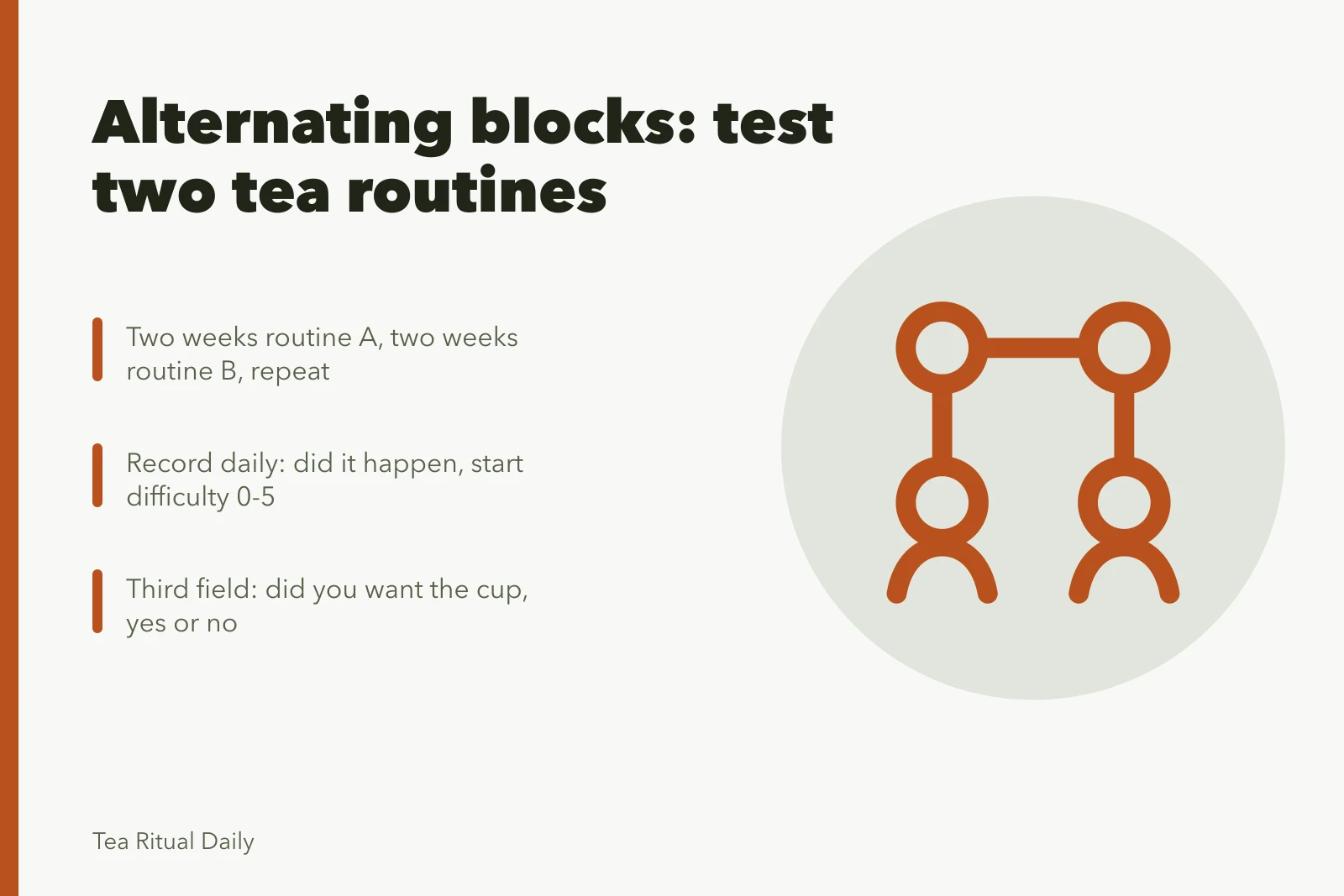
- Run one alternating blocktwo weeks of ritual A, two weeks of ritual B, then repeat the pair. Four blocks, eight weeks, one daily record throughout.
Five named tea rituals, and the conditions behind them
The five home trials, with the outcome and the condition that decided it:
Five named tea rituals
Outcome
- 6 am gongfu set
- Eleven weeks
- Office grandpa brew
- Ran at a fixed desk, stopped on a hot desk rotation
- Sunday side-by-side
- Weekly sessions, not a daily habit
- Evening cold brew
- One full summer
- Tea-and-book twenty minutes
- One book
Deciding condition
- 6 am gongfu set
- Kettle and gaiwan stay on the counter
- Office grandpa brew
- Eight-second refill, no equipment
- Sunday side-by-side
- Ninety minutes of unbroken attention
- Evening cold brew
- Refrigerator shelf space
- Tea-and-book twenty minutes
- A book that kept its place by the pot
The 6 am gongfu set. The home trial used one 100 ml gaiwan, 5 g of leaf, 100 C water, and a ten-second first steep. It gave the same cup every morning for eleven weeks. The condition was that the kettle and gaiwan never left the counter. Packing them away each night ended the run in four days.
Sen no Rikyū codified chanoyu in 16th-century Japan, and dedicated tea rooms, prescribed utensils, and hereditary iemoto schools kept it repeatable.
The office grandpa brew. The home trial used 3 g of rolled oolong in a 400 ml tumbler, topped up all day. It survived because refilling took eight seconds and needed no equipment. It failed for anyone on a hot desk rotation, since the tumbler had to move.
Chinese grandpa style keeps leaves in a glass or mug topped up through the day, and it holds where the desk and the hot water are fixed.
The Sunday side-by-side. The home trial used two 150 ml vessels, 4 g each, with one variable changed. It ran as a weekly session and never became a daily habit. This is the only ritual here that produces knowledge rather than habit, and it needs ninety minutes of unbroken attention.
Japanese tōcha was a medieval tea tasting contest. Judges compared teas from named gardens and awarded prizes for correct identification. The result was demand for specific tea gardens. The condition was social competition and trained palates, not a quiet morning.
The evening cold brew. The home trial used 8 g per liter, twelve hours in the refrigerator, poured over ice at 9 pm. It ran for a full summer. The condition was refrigerator space, and it stopped when the shelf was needed for food.
Japanese mizudashi steeps leaves overnight in the refrigerator for a sweeter, lower-bitterness cup, and it needs overnight refrigerator space.
The tea-and-book twenty minutes. The home trial used a 200 ml pot, one steep, and no phone in the room. It lasted exactly as long as the book did, so the run is measured in books, not weeks. The condition was a book that kept its place by the pot.
Anna, 7th Duchess of Bedford introduced afternoon tea in England in the 1840s, and it held where household staff, tea imports, and a long evening gap lined up.
Why the conditions matter more than the tea
A tea comparison is two cups at one moment. A ritual comparison runs over weeks, in a life that is changing anyway. Work travel and seasons move the ground under you, so no routine gets a clean test.
Two candidates worth putting head to head sit among five small routines, each attached to a cue.
Record three things, and only three
Record three things
- Did it happen
- Yes or no
- How hard was it to start
- 0 to 5
- Did you want the cup
- Yes or no
Anything longer goes unfilled after the first week, and a partial record is worse than a short one.
Ask answerable questions
A think-aloud study had twenty participants narrate their thoughts while working through two common habit measures across four behaviors, and the analysis set out the problems participants hit completing those measures.
So ask what a stopwatch could check. Did I do it today is answerable in a second. How automatic does this feel on a seven-point scale gets a different answer on Monday than on Friday for reasons that have nothing to do with tea.
Your baseline is not your friend's
People differ in how habitual they are overall. The Creature of Habit Scale, a validated 27-item questionnaire, was built to measure individual differences in habitual responding in everyday life, splitting routine behavior from automatic response.
You do not need the scale. The point is that some people form routines easily, so your eight-week record against a friend's describes the two of you, not the rituals. Palate varies the same way, which is why a pairing works for one person and falls flat for the friend beside them.
Reading the result
Count the yes answers per ritual and average the difficulty scores. If one ran 24 days out of 28 and the other 15, the comparison is settled.
If both ran about equally, keep the one you wanted the cup from more often. The tasting method that goes inside either block is in how to taste and compare specialty tea at home, and the longer write-ups are in lessons from real-world tea ritual case studies.
Common questions
Can I compare three rituals?
Not usefully. Three blocks of two weeks, repeated, is twelve weeks and too much drift. Two is the practical limit.
What if something disrupts a block?
Note it and finish the block. Dropping disrupted weeks selects for good weeks and biases the answer.
Should I keep the same tea in both rituals?
Yes. Change the tea as well and you have compared two things at once, so the result belongs to neither.
Is eight weeks really necessary?
For a fair answer, yes. Two weeks measures novelty. Eight measures the ritual.