Reviews
Part of Ritual, not invention: what real case-study research says about a tea habit
Ritual case studies show routine drinkers and browsers want opposite things
What a shop needs to support daily tea drinkers: the routine drinker and the browser need opposite things from a tea shelf. What to stock, what never to run out.
What to take away
- Ritual case studies show routine drinkers and browsers want opposite things. A shop's most valuable customer is the one who drinks the same tea every morning, and that customer needs different things from a browser.
- Confidence in performing a behavior predicts whether it becomes automatic, so instruction is a retention tool, not a courtesy.
- Routine drinkers need availability above novelty. Running out of a house tea breaks something you cannot easily rebuild.
- Stock for the routine and merchandise for the browser. They are two different jobs on one shelf.
- Yorkshire Tea, Harney & Sons, Mariage Frères and Upton Tea Imports sell to the routine side.
- Adagio Teas, DAVIDsTEA and Teavana built their catalogs for the browser.
The two customers in the Ritual case studies
A browser wants variety, samples and something new every visit. A routine drinker wants the same tea, in stock, at a predictable price, in a size that lasts a month.
Yorkshire Tea, blended by Taylors of Harrogate, is held to one fixed recipe, so a 250 g box tastes the same wherever it was bought. Boxes run typically $6 to $10 at US grocery stores and online.
Harney & Sons, based in Millerton, New York, sells Paris and Earl Grey Supreme in 4 oz tins and 1 lb bags. Fixed recipes make restocking predictable, and a 1 lb bag of Paris typically costs $35 to $50.
Mariage Frères opened in Paris in 1854 and sells Marco Polo and Wedding Imperial in fixed 100 g and 200 g tins. House blends are composed from several origins to one profile, so the cup holds across harvests. A 100 g tin typically runs 18 to 25 euros.
Adagio Teas, based in Garfield, New Jersey, lets customers design and name their own blends and hosts thousands of them. Most sell for roughly $9 to $16 per 3 oz pouch.
DAVIDsTEA built more than 200 stores around rotating seasonal blends and novelty flavors, then closed most of them in 2020 and moved online. Starbucks bought Teavana in 2012 for about $620 million and had closed its roughly 380 shops by 2018.
Browser vs routine drinker
Browser
- Range
- Wide
- Size
- Small
- Availability
- Not critical
- Information
- Origin stories
- Price
- Per item
Routine drinker
- Range
- Narrow and stable
- Size
- 100 g and up
- Availability
- Critical
- Information
- Parameters and dates
- Price
- Per gram, stable
In other categories, transparent labeling beat price as a signal. Most tea shops are laid out entirely for the browser and then wonder why repeat business is thin.
Both are worth having. The mistake is treating them as one customer, because the shelf that serves a browser well is the shelf that lets a routine drinker's tea run out.
The two customers
Browser
- Range
- Wide
- Size
- Small
- Availability
- Not critical
- Information
- Origin stories
- Price
- Per item
- Named cases
- Adagio Teas, DAVIDsTEA, Teavana
Routine drinker
- Range
- Narrow and stable
- Size
- 100 g and up
- Availability
- Critical
- Information
- Parameters and dates
- Price
- Per gram, stable
- Named cases
- Yorkshire Tea, Harney & Sons, Mariage Frères, Upton Tea Imports
Price per gram is the row that decides it. A 250 g box at $8 works out to about 3 cents a gram. A 3 oz pouch at $14 works out to about 16 cents a gram, and the pouch is gone in two weeks.
Those are typical shelf prices, not quotes. A fixed pack size keeps the number steady, which is what the routine drinker is buying.
Brewing instruction as a retention tool
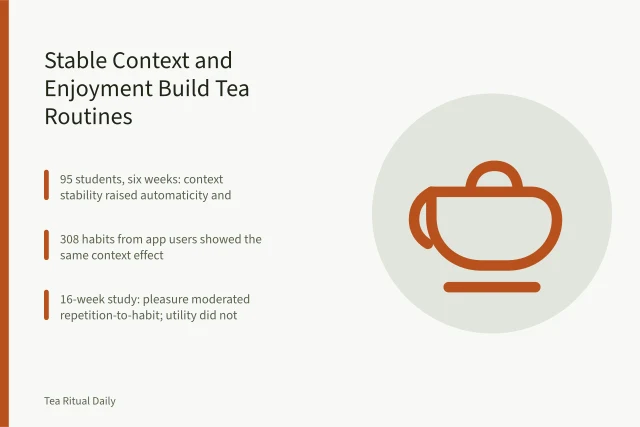
Research on intentional habit building analyzed data from a habit-tracking app across two studies and found self-efficacy predicted automaticity, with a positive feedback loop.
That argues for one thing at the counter: teach the customer to make the tea correctly before they leave. Harney & Sons prints brewing time and water temperature on its tins, so the instruction leaves the shop with the customer.
A person who can reliably produce a cup they like will keep buying that tea.
Who actually buys by the pound
Do not assume younger customers are the habitual ones.
A four-week study of daily placebo pill adherence in 68 younger and 63 older adults found older adults adhered better than younger adults and reported higher subjective automaticity.
That maps onto what most tea retailers already see: standing orders and large-format repeat purchases skew older. Harney & Sons sells Paris by the pound for regulars, and Celestial Seasonings has kept Sleepytime in grocery aisles since 1972, typically $3 to $5 for a 20-count box.
Marketing built entirely around novelty aims at the customers least likely to come back for the same thing.
Novelty usually sells as an origin story; the documented history belongs to the materials, not a company.
The stock checklist for routine drinkers
Stock checklist for routine drinkers
- Three to five house teas that never go out of stock, the way Harney & Sons holds Paris and Mariage Frères holds Marco Polo.
- 100 g and 250 g sizes for those teas, priced per gram.
- Parameters printed on every pack, per lot.
- A standing order or reserve option, however informal.
- Notice before a lot changes, not after.
Turn the par level from cups, not from a feeling. Fifteen cups of one house tea a day at 3 g a cup is 45 g daily, about 1.4 kg a month. A 250 g box then turns every five or six days.
Two weeks of cover is three boxes. Set the reorder point at two boxes and the par level at four, and review both when the cup count changes.
Upton Tea Imports, based in Holliston, Massachusetts, lists lot number, estate, crop year and grade with each catalog entry and sells 100 g and 250 g packs, typically $6 to $12 for a single-estate 100 g.
The last point does most of the work. A routine drinker who receives a different lot without warning experiences it as a fault. Told in advance, they experience it as a harvest, which is what it is.
Stocking for routine drinkers
- Three to five house teas never out of stock
- 100 g and 250 g sizes, priced per gram
- Parameters printed on every pack, per lot
- Standing order or reserve option
- Notice before a lot changes, not after
The operational and compliance side of stocking is in a retailer checklist for stocking specialty tea, and what the customer is trying to build is described in lessons from real-world tea ritual case studies.
Common questions
How many house teas should never run out?
Three is workable, five is comfortable. Beyond that you are holding stock that turns too slowly.
Should I offer subscriptions?
A simple standing order works better than a monthly selection box for this customer. They want the same thing, not a surprise.
What if the harvest changes the tea?
Say so, offer a taste, and price the transition honestly. Handled openly it strengthens the relationship.
Is teaching brewing worth the counter time?
It is the highest-return ninety seconds available to you, on the evidence that confidence and automaticity reinforce each other.
Which shops already run this way?
Yorkshire Tea, Harney & Sons and Mariage Frères hold blends to a fixed recipe. Upton Tea Imports publishes lot and crop details, and Adagio Teas sells the browsing side.