Industry
Part of Ritual, not invention: what real case-study research says about a tea habit
Tea ritual trends: what to keep and what to drop for 2027
Six tea ritual habits worth keeping into 2027, four worth dropping, and the brewing measurements and leaf ratios that decide which is which.
What to take away
- Tea ritual trends for 2027 split into six habits to keep and four to drop.
- Keep the gram scale, preheated vessel, rinse, shared pot and tasting note. Keep the single-origin lot too.
- Drop the blooming social pour, the five-gram scoop, the boiling kettle on green tea and the teaware bought for looks.
- Weigh leaf in grams per 100 ml of water. A 1:20 ratio means 5 g to 100 ml; a 1:15 ratio means about 6.7 g.
- Steep temperature and time change extraction more than most gear does. Green tea wants cooler water than black.
- A trend earns a place in your routine only if it changes what you taste, not what you photograph.
Six tea ritual trends to keep for 2027
Weighing leaf in grams. A teaspoon of broken Ceylon and a teaspoon of whole oolong weigh different amounts. Use a gram scale such as the Acaia Pearl (about $150) or Jennings CJ-4000 (about $30). Grams per 100 ml fixes strength and makes every other habit repeatable.
Preheating the vessel. A cold gaiwan pulls heat from the first pour. Rinse the pot with hot water, pour it off, then add leaf. A porcelain gaiwan from Yunnan Sourcing or Teasenz often costs $20 to $40 and warms faster than thick stoneware. The first steep then matches the second.
The rinse on rolled and compressed tea. A two-second rinse on a balled oolong or a pressed cake loosens the leaf and washes off dust from pressing. Try a Dong Ding oolong or a Menghai 7542-style raw cake. Skip it and the first steep tastes flat and dusty at once.
One pot, several small pours. Gongfu style splits a steep across four or six small cups. Everyone drinks from the same steep, so the comparison is fair, and the leaf gets a second and third life. A 100 ml gaiwan or a 150 ml Yixing pot suits this.
Writing down what you tasted. Note aroma family, astringency, and how the third steep differed from the first. A dated note on the bag turns a pleasant cup into a repeatable one. Use a pocket notebook or a spreadsheet; both beat memory.
Buying one lot at a time. A lot code ties a bag to a harvest date and a supplier record. When you reorder, you can tell whether the tea changed or your water did. Ippodo, Harney & Sons and Rishi Tea sell single-origin or single-lot teas.
!image
Four tea ritual trends to drop for 2027
The blooming pour for the camera. A long, high pour cools the water and agitates the leaf. It photographs well and brews worse. Pour low and steady.
The scoop as a unit. 'One scoop per cup' is not a measurement. It is the most common cause of bitter tea in a home kitchen, and it is free to fix. A teaspoon holds about 2 g of broken black tea but 4 to 5 g of dense rolled oolong.
Boiling water on every tea. Green and white teas scorch at a full boil. Cool the kettle, or pour into a pitcher first, then onto the leaf. A variable-temperature kettle such as the Bonavita 1.0L (about $60 to $100) or Fellow Stagg EKG (about $165) holds 80 C.
Teaware bought for finish. A $200 pot with thick walls holds heat unevenly and pours badly. A $30 gaiwan with a clean spout brews better. Buy geometry, not glaze.
The measurements behind the 2027 list
Every keep and drop above turns on three variables: leaf weight, water temperature and time. Hold two and change one, and you learn what that one does.
| Variable | Starting point | What it changes |
|---|---|---|
| Leaf ratio | 5 g per 100 ml | Strength and how many steeps you get |
| Water temperature | 80 C green, 95 C black | Astringency and aroma release |
| Steep time | 20 to 45 seconds | Bitterness on the finish |
| Longjing green tea | 3 g per 100 ml, 75 to 80 C, 30 seconds | Sweetness, less spinach bite |
| Dong Ding oolong | 5 g per 100 ml, 90 C, 25 seconds | Floral aroma and lingering finish |
| Keemun black tea | 5 g per 100 ml, 95 C, 20 seconds | Malt and cocoa notes |
| Silver Needle white tea | 4 g per 100 ml, 80 C, 45 seconds | Honey and hay notes |
Altitude shifts the boiling point, so a kettle at 1,500 m boils cooler than one at sea level. Water chemistry matters too: hard water mutes aroma, and a soft, low-mineral water lets it through. If your tea tastes flat after a move, the water changed before the tea did.
What to keep in the shop for 2027
Stock for the customer who returns. A retailer's shelf should carry one lot each of a green, a rolled oolong, a black and a pressed tea, dated and labeled with harvest.
Try Longjing or Sencha for green. Dong Ding suits the rolled oolong slot. Keemun or Assam covers black, and a Menghai 7542-style raw cake covers pressed. The retailer checklist for stocking tea ritual case studies walks through the shelf decisions.
Track portion cost per cup rather than price per bag. Divide the bag price by the grams in it, then multiply by the grams per serving. A 100 g bag at 5 g per cup gives 20 cups. At $20 per bag, that is $1 per cup.
Where the trends come from
Buyer behavior in 2027 will show up first in what shops reorder, not in what they display. The specialty tea trends that buyers may notice in 2027 covers the supply side of that shift.
On the brewing side, the mistakes that read as trend-chasing are the same ones that read as bad tea. The tea brewing mistakes trends that buyers may notice in 2027 lists them by symptom.
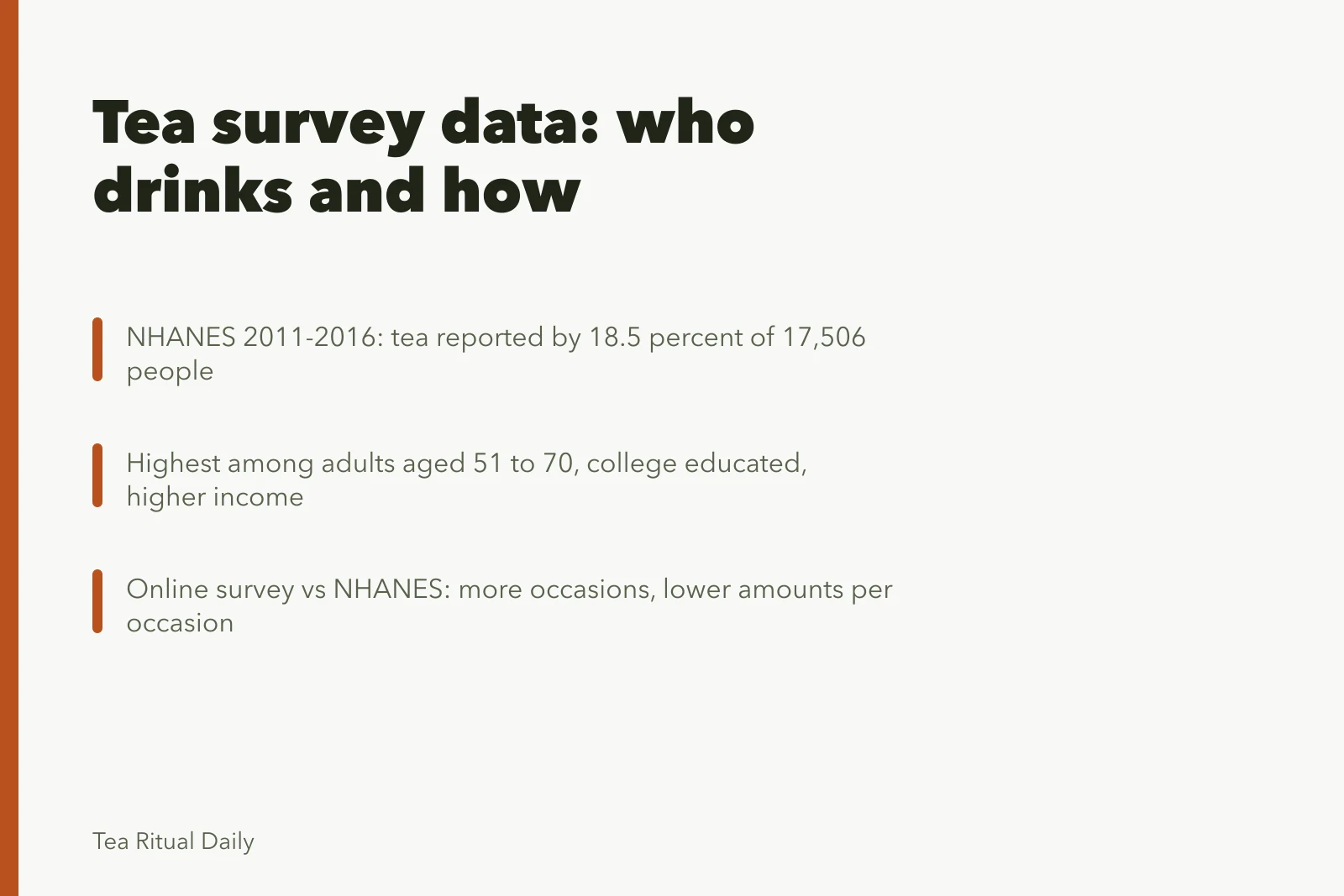
Two peer-reviewed sources frame the consumer side. NHANES 2011 to 2016 reported tea consumption among 18.5 percent of the sample, highest in adults aged 51 to 70. A separate validation study found online survey respondents reported more consumption occasions per day and smaller amounts per occasion than dietary recall respondents did. Different instruments, different pictures.
Case notes from shops that tested these changes are collected in lessons from real-world tea ritual case studies.
Common questions
Is loose leaf actually better than bags?
Leaf grade and freshness matter more than the format. A stale loose leaf loses to a fresh bagged tea, and a broken-grade bag can beat a poorly stored cake. Weigh both, brew both at the same ratio, and compare.
How many times can I resteep the same leaf?
It depends on the tea. A balled oolong often gives five to seven steeps; a broken black gives two or three. Add five seconds per steep and stop when the aroma fades.
Do I need a scale and a thermometer?
A scale first. Leaf weight is the variable most people get wrong, and a kitchen scale reads to a gram. A thermometer helps on green and white tea, where a few degrees change the cup.
Is any of this a health claim?
No. This article covers brewing measurements and shop practice only. Questions about caffeine, sleep or diet belong with a licensed clinician or dietitian.