Industry
Part of How American tea brands actually grow, and the research station behind most of it
Why American tea brands work better as a special than a fixed list
What US-grown tea has: domestic origin is something a customer cannot taste, and supply rarely lasts a year. How to run US-grown tea as a special rather than a list.
What to take away
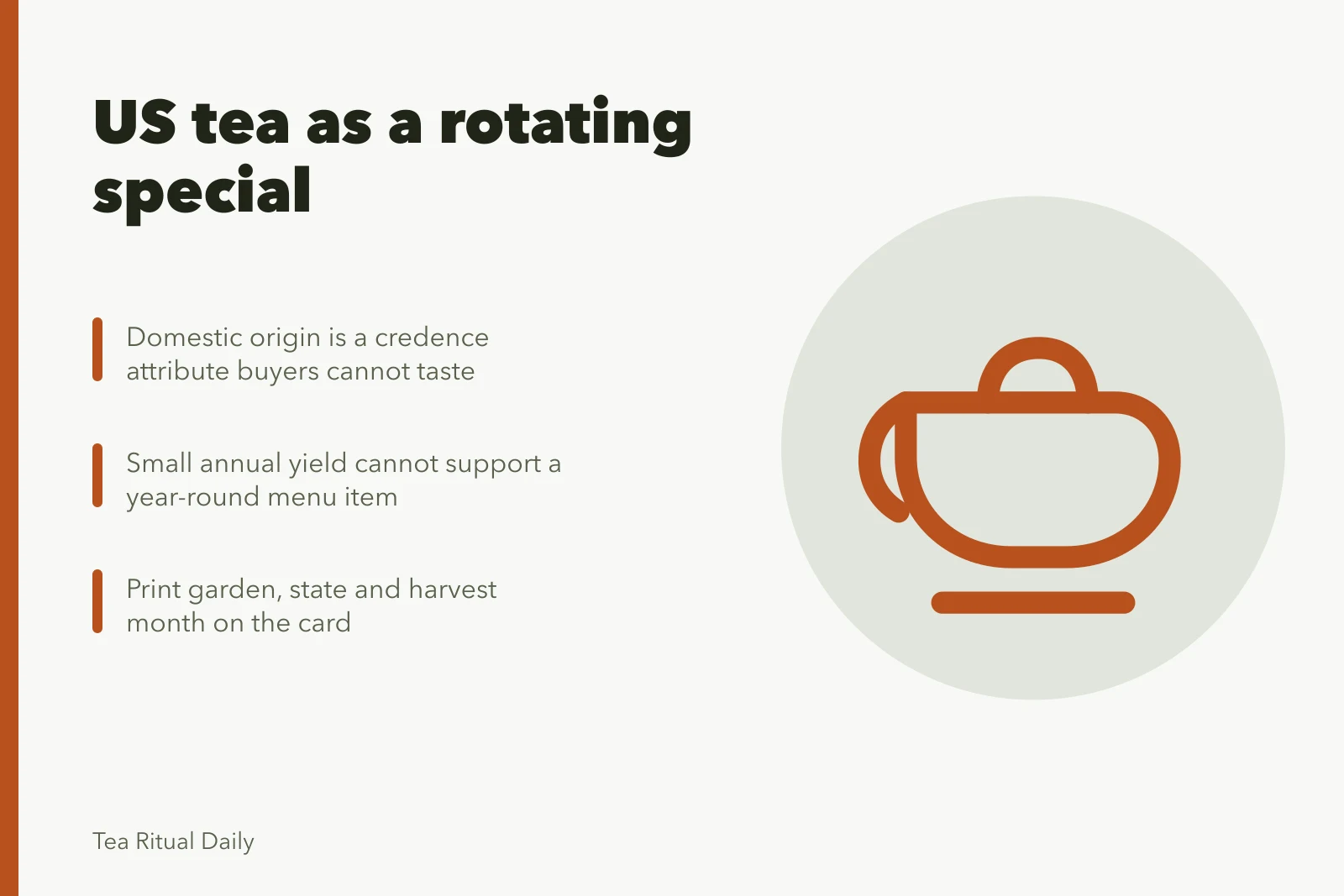
- Domestic origin is a credence attribute: the customer cannot verify it in the cup, so it depends entirely on how you communicate it.
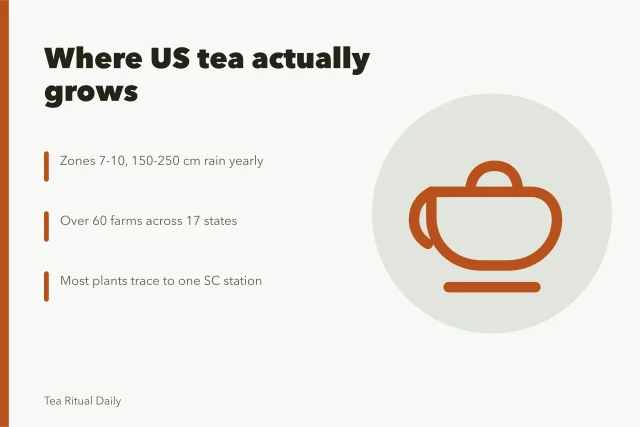
- Volume is the binding constraint. Most US gardens cannot supply a menu item year round.
- Artisanal and local positioning works where there is a story infrastructure around it, and less well where there is not.
- Treat domestic tea as a rotating special with a written provenance, not as a standing list item.
Origin is something the buyer has to be told
A customer can taste whether a tea is good. They cannot taste where it grew. Domestic origin is a credence attribute.
The literature is direct about the consequence. A framework study of food credence attributes calls them quality characteristics that cannot be assessed by buyers at the point of sale without additional information, producing information asymmetry between the parties.
It also reviews the assurance mechanisms that address the gap, and their limits: standards as a barrier to entry, limited harmonization, and communication problems including how consumers process and trust the signal.
For a shop, that means the claim has to be backed by something concrete on the menu or the shelf card. The garden name, the state, the harvest month. A card that just says American grown asks for trust you have given no reason to extend.
Volume is the real problem
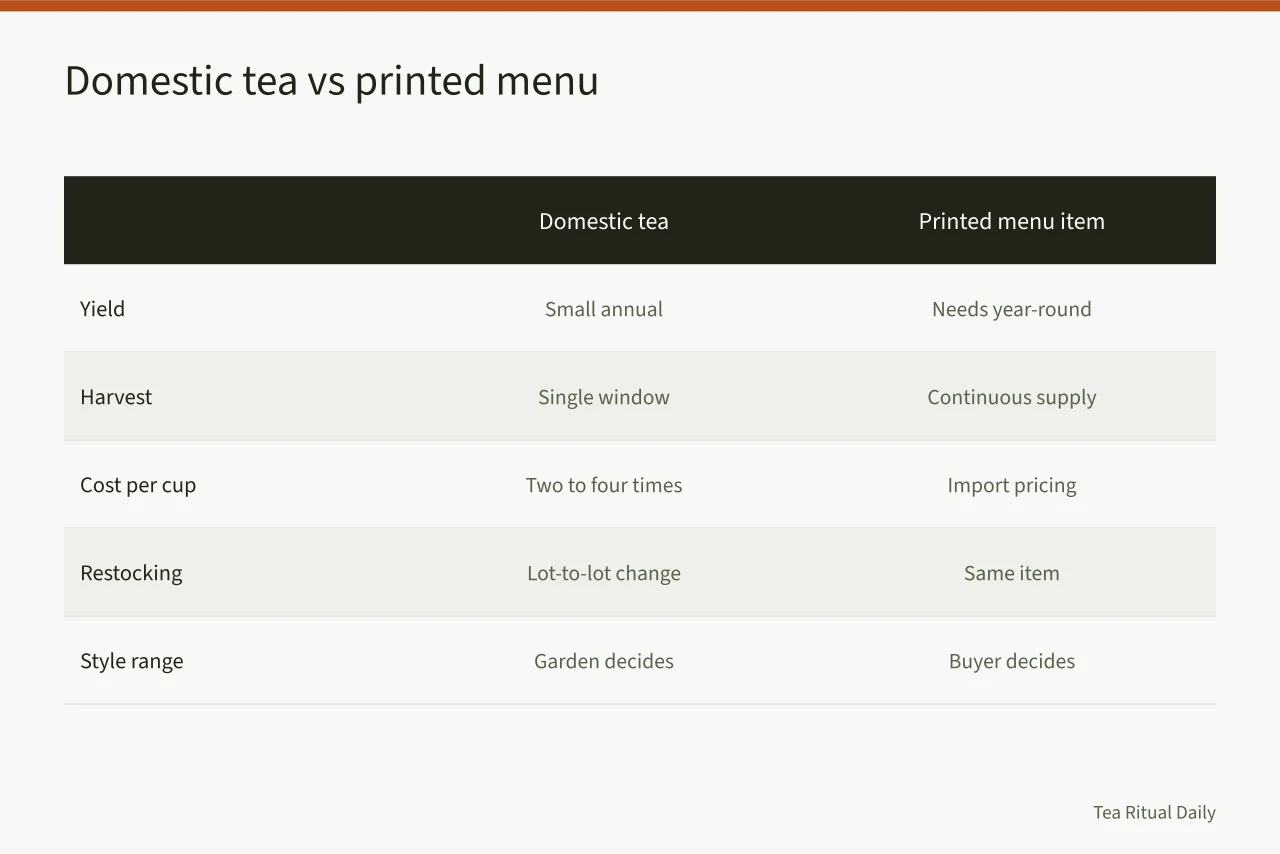
| Constraint | Effect on a menu |
|---|---|
| Small annual yield | Cannot support a year-round item |
| Single harvest window | Supply arrives once, then stops |
| High price per pound | Cost per cup often two to four times imports |
| Lot-to-lot variation | The item changes when you restock |
| Limited style range | You take what the garden made |
Every one of these argues for the same handling. Domestic tea belongs on a specials board with a date and a quantity, not on a printed menu you cannot reprint.
Local positioning works where the surroundings support it
Research on artisanal food producers found that the sector performs better where the context supports it. A study of registered artisanal producers by region reported that areas with stronger household production and cultural engagement showed higher activity in the artisanal food sector.
It stressed cultural and tourism infrastructure for product visibility, and self-sufficiency in raw material sourcing for differentiation.
That study is about Ukraine, so treat the mechanism as transferable, not the numbers.
A domestic tea sells where the shop is already part of a local food conversation. It struggles where it is one unexplained line on a price list. Saying it the same way twice is a training problem, and repeatability comes from replication rather than talent.
How to actually run it
- Buy the whole lot you want up front. There is no reorder.
- Print the garden, the state and the harvest month on the card.
- Price it as a special and explain the price in one sentence.
- Serve it in a format that shows it off, not buried under milk.
- Tell staff two facts about it they can say without reading.
The general menu constraints are unchanged and are set out in how shops and bars choose loose leaf tea, and the supply-side picture is in who is doing interesting work in American tea brands.
Common questions
Will customers pay more for domestic tea?
Some will, if they are told why in one sentence at the point of sale. Very few will if they have to work it out from the price alone.
Should we buy direct from the garden?
Usually yes, at this scale. It also gets you the provenance details you need for the card.
What if the lot sells out mid-season?
Say so and move on. Scarcity handled openly is fine. Substituting quietly is how a shop loses the credibility the item was built on.
Is it worth it commercially?
As a rotating special that anchors your other tea, often. As a volume item, rarely, because the supply does not exist.