Guides
How to Store Loose Leaf Tea Long Term: A Shelf-Life Checklist
A room by room shelf life checklist for loose leaf tea, with real timelines for opened versus sealed leaf and a pantry audit to run before buying more.
What to take away
- Sealed loose leaf keeps peak flavor for about 12 to 24 months. Opened leaf often fades in 6 to 12 months.
- Tea type sets the clockgreen tea goes flat fastest, black tea holds longer, and pu-erh is built to age.
- Oxygen, light, heat, moisture, and strong odors shorten shelf life more than the calendar does.
- Audit what you already own before buying more, then replace any tin with a cracked gasket.
Opened leaf versus sealed leaf timelines
A sealed pouch of loose leaf is a closed system. Nitrogen flushed foil and a tight seal keep oxygen out, so many green teas hold for 12 to 18 months past the pack date and black teas for 24 months or longer.
Sealed vs Opened Tea Shelf Life
Sealed, unopened
- Green
- 12 to 18 months
- Light oolong
- 12 to 18 months
- Roasted oolong
- 18 to 24 months
- Black
- 24 to 36 months
- Pu-erh
- Years to decades
Opened, airtight tin
- Green
- 6 to 8 months
- Light oolong
- 8 to 10 months
- Roasted oolong
- 12 months
- Black
- 12 to 18 months
- Pu-erh
- Years
Cut the bag open and the clock speeds up. Every time you lift the lid, humid room air replaces the dry air inside. Opened green tea usually tastes flat within 6 to 8 months.
Tea freshness after opening depends on how much air you admit and how often. Leaf that has seen more oxidation fades on a slower curve. Roasted oolong and black tea carry sugars and roast notes that fade later, and pu-erh keeps changing for years when the room stays stable.
Wikipedia's article on tea explains how oxidation and processing shape what is left in the leaf, which is the material you are protecting.
Opened versus sealed timelines
Sealed, unopened
- Green
- 12 to 18 months
- Light oolong
- 12 to 18 months
- Roasted oolong
- 18 to 24 months
- Black
- 24 to 36 months
- Pu-erh
- Years to decades
Opened, airtight tin
- Green
- 6 to 8 months
- Light oolong
- 8 to 10 months
- Roasted oolong
- 12 months
- Black
- 12 to 18 months
- Pu-erh
- Years
Tea storage container comparison
The question of how to store loose leaf tea long term comes down to two barriers: air and light. A double lid tin with a silicone gasket is the workhorse for daily leaf. Food grade Mylar with an oxygen absorber suits anything you will not open for a year.
Tea Storage Container Comparison
Air barrier
- Double lid tin
- Good
- Mylar pouch with oxygen absorber
- Excellent
- Clear glass jar
- Poor
- Vacuum canister
- Good
- Ceramic caddy with gasket
- Good
Light barrier
- Double lid tin
- Good
- Mylar pouch with oxygen absorber
- Excellent
- Clear glass jar
- None
- Vacuum canister
- Varies
- Ceramic caddy with gasket
- Excellent
Best for
- Double lid tin
- Daily leaf, 50 to 100 g
- Mylar pouch with oxygen absorber
- Leaf sealed for a year or more
- Clear glass jar
- One week of leaf at most
- Vacuum canister
- Counter use and frequent opening
- Ceramic caddy with gasket
- Gifts and short term storage
Air barrier
- Double lid tin
- Good
- Mylar pouch with oxygen absorber
- Excellent
- Clear glass jar
- Poor
- Vacuum canister
- Good
- Ceramic caddy with gasket
- Good
Light barrier
- Double lid tin
- Good
- Mylar pouch with oxygen absorber
- Excellent
- Clear glass jar
- None
- Vacuum canister
- Varies
- Ceramic caddy with gasket
- Excellent
Best for
- Double lid tin
- Daily leaf, 50 to 100 g
- Mylar pouch with oxygen absorber
- Leaf sealed for a year or more
- Clear glass jar
- One week of leaf at most
- Vacuum canister
- Counter use and frequent opening
- Ceramic caddy with gasket
- Gifts and short term storage
Clear glass looks good and protects nothing. A jar on a sunny shelf can bleach green tea in a few weeks.
Moisture is the threat that ends a tin early. Lab methods such as the ASTM tea testing standards measure moisture and caffeine in leaf, and dry leaf is the goal.
Five pantry threats and how each one works
Five pantry threats
- Oxygen. It oxidizes aromatic oils, so floral leaf starts smelling like hay.
- Light. Ultraviolet exposure breaks down chlorophyll and catechins, especially in green and white tea.
- Heat. A cabinet beside the oven cycles warm and cool, pushing moisture in and out of the leaf.
- Moisture. Steam, a damp basement, or a wet spoon invites mold and off flavors.
- Odor. Tea is porous and picks up coffee, spices, and cleaning sprays within days.
The WHO food safety fact sheet covers handling principles for dry goods at home, including keeping containers clean and dry.
Five Pantry Threats
- Oxygenoxidizes aromatic oils, floral leaf smells like hay
- LightUV breaks down chlorophyll and catechins
- Heatcabinet beside oven cycles warm and cool
- Moisturesteam, damp basement, wet spoon invite mold
- Odortea picks up coffee, spices, cleaning sprays
Example: auditing a three year old tin
If the leaf crumbles to dust and smells like paper, the tin failed. If it bends and smells like the day you bought it, the tin worked.
Four Checks on an Open Tin
- Open far from sink and sniff dry leaf
- Squeeze a pinchfresh bends, stale snaps
- Inspect rim and gasket for rust or cracks
- Brew 3 g at 175 F for one minute
Run the same four checks on every open container in the house.
Auditing a three year old tin
- Open the tin far from the sink and sniff the dry leaf.
- Squeeze a pinch. Fresh leaf bends and stale leaf snaps.
- Inspect the rim and gasket for rust, cracks, or a wide gap.
- Brew 3 grams at 175 F for one minute and taste for flatness.
Room by room storage checklist
- Pantrytop shelf, away from the stove, oven, and dishwasher.
- Counteropaque tin, never beside a window or under the kettle.
- Freezervacuum sealed leaf only, thawed sealed for 24 hours before opening.
- Fridgeskip it, because condensation forms each time the door opens.
- Garage or basementskip unless the space stays dry and near 70 F.
Most pantry tea storage mistakes trace back to one cabinet that shares heat with the stove. A kitchen that runs hot shortens every timeline above.
Room by Room Storage Checklist
- Pantrytop shelf, away from stove and dishwasher
- Counteropaque tin, never beside window or kettle
- Freezervacuum sealed only, thaw sealed 24 hours
- Fridgeskip it, condensation forms each door opening
- Garage or basementskip unless dry and near 70 F
Cross border orders, label claims, and gifts
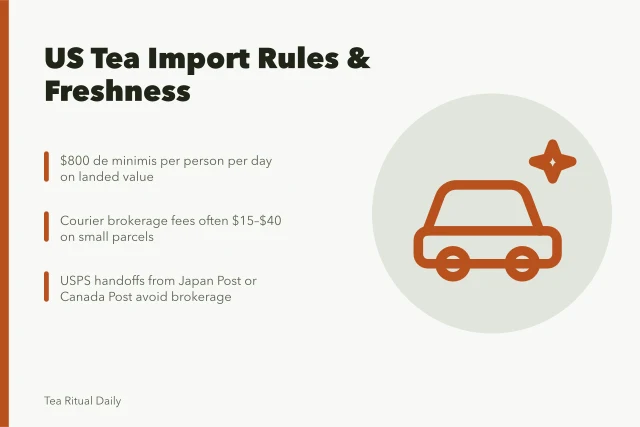
Ordering tea from Canada or Japan brings its own freshness math. A parcel can sit in customs, and the $800 de minimis threshold decides whether duty applies. Arrival time matters as much as the pack date.
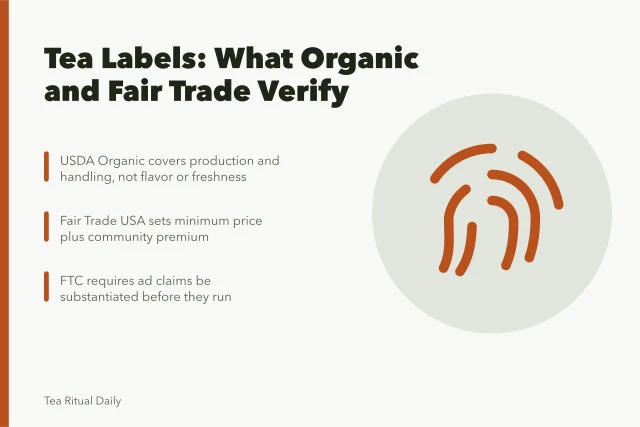
Organic and fair trade marks describe farming and trade terms, not age. Knowing what USDA Organic verifies helps you read a box without confusing certification for a shelf life promise.
Gift buying rewards the same discipline. For under $50, specialty tea gift sets from Rishi, Smith, Adagio, Harney, and Art of Tea work best when you know how fast the recipient drinks and how much shelf space they have.