Features
Tea Storage Humidity Packs: What Actually Protects Loose Leaf
Loose leaf holds best at 58 to 62 percent relative humidity. Which two-way packs to buy, where to place them, how to read a hygrometer, and the mistakes to avoid.
What to take away
- Most finished loose leaf holds best between 58 and 62 percent relative humidity, a narrow band a two-way pack can maintain.
- Set the pack in the lid or behind a divider so it never rests against the leaf.
- Verify the number with a digital hygrometer rather than trusting the pack on its own.
- Replace a pack once it turns stiff, and keep the container closed in a cool room.
Why Loose Leaf Pulls Moisture From the Air
Dry tea leaf is hygroscopic. It absorbs water vapor from the surrounding air, and it absorbs aroma the same way. That is why a tin left beside ground coffee ends up tasting like coffee. Leaf absorbs aroma the same way it absorbs water, a trait covered in this overview of tea.
When relative humidity rises past roughly 70 percent, mold and bacteria can grow on the leaf, a hazard that general food safety guidance treats as a handling concern.
Below about 55 percent, leaf turns brittle and the aromatic compounds that carry flavor fade faster. Green and white styles show the shift first. White tea, among the least oxidized styles, loses its fresh character faster when the air around it is dry.
The Range That Works: 58 to 62 Percent
Retailers and two-way pack makers tend to settle on 58 to 62 percent relative humidity for finished leaf. Two-way packs hold a target number in both directions. In a dry room they release moisture. In a damp room they absorb it. Boveda is the best known brand. Integra Boost is the other common choice.
Target Humidity by Tea Type
Green and white
- Target RH
- 58-60%
- Note
- Aroma shifts fastest
Oolong
- Target RH
- 58-62%
- Note
- Ball rolled higher end
Black
- Target RH
- 58-62%
- Note
- Wider tolerance
Aged puerh
- Target RH
- 60-70%
- Note
- Slow microbial aging
The Range That Works
| Tea type | Target relative humidity | Note |
|---|---|---|
| Green and white | 58 to 60 percent | Aroma shifts fastest here |
| Oolong | 58 to 62 percent | Ball rolled types prefer the higher end |
| Black | 58 to 62 percent | Wider tolerance than green |
| Aged puerh | 60 to 70 percent | Aging depends on slow microbial activity |
Pack Placement: Five Steps
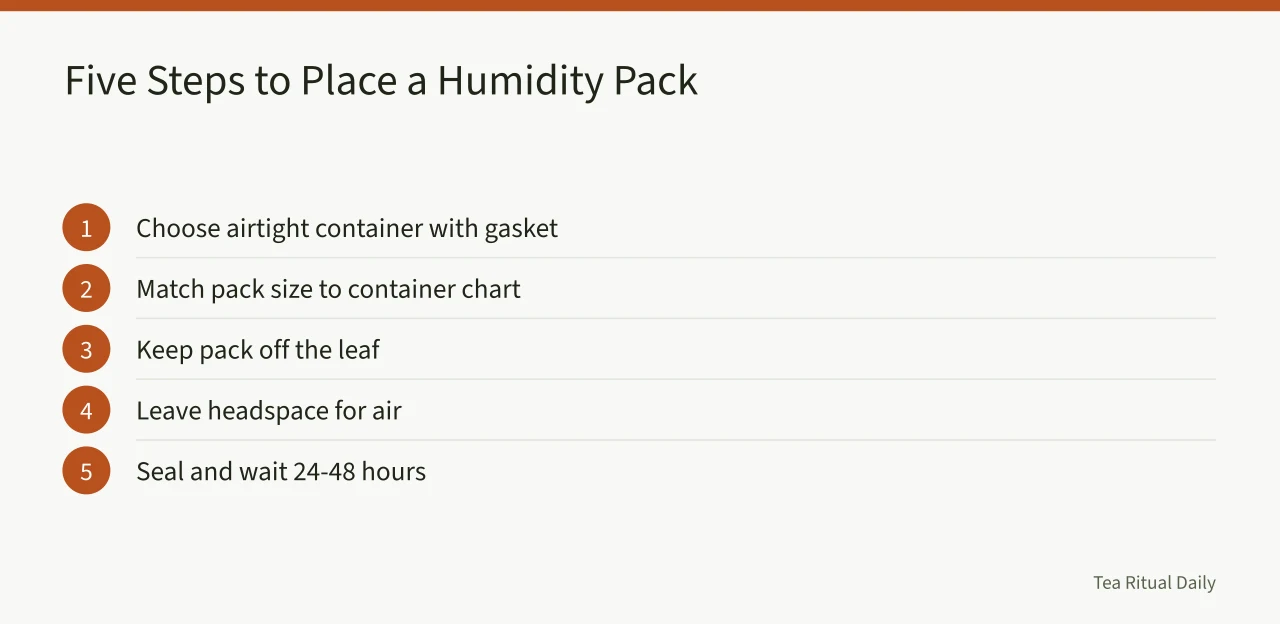
- Choose an airtight container with a gasketa double lid tin, a Mylar bag, or a clamp-lid glass jar.
- Match the pack size to the container using the maker's coverage chart instead of guessing.
- Keep the pack off the leaf. Set it in the lid recess or on a card above the tea.
- Leave headspace. A jar filled to the rim has no air for the pack to condition.
- Seal the container and wait 24 to 48 hours before judging the reading.
Reading the Number
A small digital hygrometer costs little and fits inside a tin. Calibrate it before you trust it.
Calibrate Your Hygrometer
- Mix salt paste with few drops water
- Seal cup and hygrometer in bag
- Wait 8 to 12 hours
- Reading should settle near 75% RH
- Note gap and apply to readings
- Stir table salt into a few drops of water to make a paste in a small cup.
- Seal the cup and the hygrometer together in a zipper bag for 8 to 12 hours.
- The reading should settle near 75 percent relative humidity. Note the gap and apply it to later readings.
Example: A One Quart Jar of Ball Rolled Oolong
A clamp-lid jar holding about 100 grams of oolong needs one small two-way pack rated for that volume. Put the pack in the lid well, not on the leaf. Wait a day, then read the hygrometer. If it holds between 58 and 60 percent, leave it alone. If it reads 65 percent or higher, open the jar for an hour in a dry room and seal it again.
Mistakes That Undo the Work
- Keeping leaf in the fridge in its original bag, where condensation forms each time it comes out.
- Reusing a spice jar whose gasket already carries other aromas.
- Opening the container daily just to smell the leaf.
- Sitting the jar near a stove, a window, or a radiator.
Ordering From Abroad
A parcel from Japan or Canada can spend days in transit, and mail conditions swing. If the leaf arrives crisp, a pack can pull some moisture back, but heat damage does not reverse. Knowing the customs and de minimis rules ahead of time helps a shipment clear quickly and land fresher.
What the Label Does Not Say
A sealed tin with a pack tells you nothing about how the leaf was grown or who was paid for it. The USDA Organic and Fair Trade USA marks are checked by different bodies with different scopes. To see which claim covers what, this comparison of organic and fair trade labels shows what each mark verifies.
Gifts That Travel Well
A jar, a pack, and a hygrometer make a useful gift for someone new to loose leaf. If you would rather buy the leaf than the hardware, this list of tea gifts under $50 names sets from Rishi, Smith, Adagio, Harney and Art of Tea.