Industry
Part of Per cup, not per tin: where a specialty teas budget actually starts
Specialty teas trends: 5 pointers for buyers
Specialty teas trends behind the leaf you buy: uneven precision-farming adoption, ancient-tree Pu'er scarcity, and five pointers for buyers as spreads widen.
What to take away
These specialty teas trends decide what a leaf costs long before it reaches a shelf.
- The cost pressures in tea are on the growing sidelabor, land, climate and the price of modernizing a garden.
- Precision agriculture is arriving in tea, but adoption is uneven because the tools cost more than smallholders can carry.
- Old-growth material is scarce partly because a large share of it is not very productive, which has been modeled directly.
- On a shelf, these forces show up as wider price ranges within a single style rather than as one general increase.
The cost pressure is upstream
Retail prices move because production costs move. The changes arriving in tea, from cultivation history through modern methods, all land first on a garden's books.
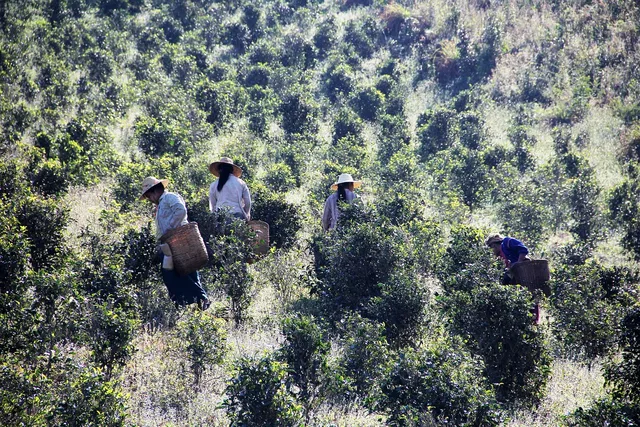
Precision agriculture tools can improve disease detection and resource use, but adoption remains uneven because of high implementation costs and limited accessibility for smallholder farming systems, plus data infrastructure problems. Productivity and quality also depend on interactions between genotype, environment and management, and climate variability disrupts those relationships.
What that means for a buyer is that two gardens in the same region can be on completely different cost curves. One has modernized; the next has not. The tea from both arrives under the same regional name. Inside a single garden, two consecutive weeks can produce very different tea, for reasons that sit on the processing floor.
American gardens sit at the far end of that contrast. A small number of US farms — Hawaii's Big Island and the Charleston Tea Garden in South Carolina among them — grow leaf for drinkers who want it fresh and local, and it reaches them as a small-batch product rather than a commodity.
Old and rare is a supply constraint, not a marketing angle
Ancient tree material from Yunnan's old Pu'er gardens carries high prices, and supply is thinner than marketing implies.
A tree-by-tree productivity model of ancient Pu'er gardens, scoring each tree by its total value, classed 53 percent of the sampled trees as poorly productive or unproductive, with environmental suitability, tree growth and management all contributing to the score.
Half a population producing little is a real reason for scarcity pricing. It is also a reason to be skeptical of how much genuinely ancient-tree tea can exist at the volumes some sellers offer.
What shows up on a shelf
| Force upstream | What a buyer sees |
|---|---|
| Labor cost and mechanization | A wider gap between hand-picked and standard grades |
| Climate variability | Year to year swings within one garden |
| Modernization costs | Some producers priced out, fewer mid-tier lots |
| Scarcity of old material | High prices and more unverifiable claims |
| Better traceability tech | More dates and cultivar names on labels |
Labels are doing more of the work now: the packs worth reading carry a picking date and a cultivar name, which is the fastest way to tell apart two gardens selling under the same regional name.
How to read a price increase
Ask what changed. A garden that raised prices after a bad season is telling you something specific and checkable. A brand that raised prices across a whole range on the same day is telling you about its cost base, not about the tea.
Reading a price increase
Supply-side increase
- Cause
- Bad season, garden costs
- Product change
- New pick, cultivar, processing
- Checkable
- Yes, specific and dated
Brand-side increase
- Cause
- Whole-range cost base
- Product change
- Same product, new box
- Checkable
- No, no product change
The distinction matters because supply-side increases usually change the product with a different pick, cultivar, or processing. Brand-side increases bring the same product in a new box, with no product change.
The pressure does not land everywhere at once. It shows up garden by garden and grade by grade, which is why two tins of the same style can sit at very different prices in the same season.
Five pointers for buyers
- Fix a favorite and buy it consistently, so you can see its price move against a constant; a widening spread inside a style only becomes visible that way.
- Buy the mid tier of a good seller rather than the entry tier of a famous one.
- Treat unverifiable scarcity claims as a price on a story; ancient-tree Pu'er is where those claims cluster.
- Watch for the same tea appearing in smaller packages at the same price.
- Keep one cheap reliable tea so a price rise is never forced on you.
Common questions
Will tea keep getting more expensive?
Nobody can tell you that honestly. What is visible is that the spread within a style is widening, which affects what you should buy more than any headline direction.
Is machine-harvested tea going to take over?
It is already most of the volume in many categories. It coexists with hand-picked material at a different price and a different quality level.
Should I buy ahead of a price rise?
Only within your drinking horizon. Stockpiling tea converts a price saving into a quality loss.
Do organic and other certifications drive prices?
USDA organic certification, for example, adds cost through auditing and yield effects. Certifications describe production conditions and paperwork, not flavor.